Film Stocks
The Kodak Library

Spectra360 is being built as a complete, expanding library of Kodak film responses—covering motion picture negatives, photographic negatives, reversal film, and a custom 2383 print response so filmmakers can choose a stock the way they would in a photochemical pipeline: as a foundational creative decision, not a superficial “filter.”
The Kodak lineup planned for release
Spectra360 will roll out the following Kodak stocks as part of the 2026 roadmap:
Kodak Vision3 500T
Kodak Vision3 250D
Custom Kodak 2383 print (motion picture print response / Custom Printed for 500T & 250D)
Kodak Gold
Kodak ColorPlus
Kodak Portra (family of portrait-focused color negative stocks)
Kodak Pro Image
Kodak Ektar
Kodak Ektachrome (reversal / slide)
Kodak T-Max (B&W)
Kodak Tri-X (B&W)
Kodak Ultramax
Each stock will be treated as its own “film behavior”—not only color, but the way the image organizes itself across exposure, saturation, and scene conditions.
What makes film meaningfully different from digital
Most digital looks can mimic a palette. Film is harder: film has behavior.
Film’s “look” emerges from a set of physical characteristics that combine into a signature response:
Density-based imaging (not display code values): Film records and reproduces image information through dye density and light transmission, which behaves differently than a display-referred digital signal.
Non-linear response shaped by chemistry: Film’s characteristic curve (H&D curve) naturally compresses and expands different parts of the exposure range in ways that feel “photographic,” especially when the image is carried through a print response.
Spectral sensitivities and dye interactions: Film layers respond to light by wavelength, and the resulting dye formation and interlayer interactions create the kind of color separation and bias people associate with specific stocks.
Contextual color (not isolated RGB): Film often feels more coherent because its response is not purely channel-independent; color and density are coupled through the medium.
A finishing step that matters: In traditional workflows, the “final look” is strongly shaped by the print stage (or print-emulation stage). That final response is part of what people actually recognize as “cinema.”
Spectra360 is designed around that premise: film is a pipeline, not a single LUT.
How Spectra360 matches digital footage to film
Capture a controlled dataset
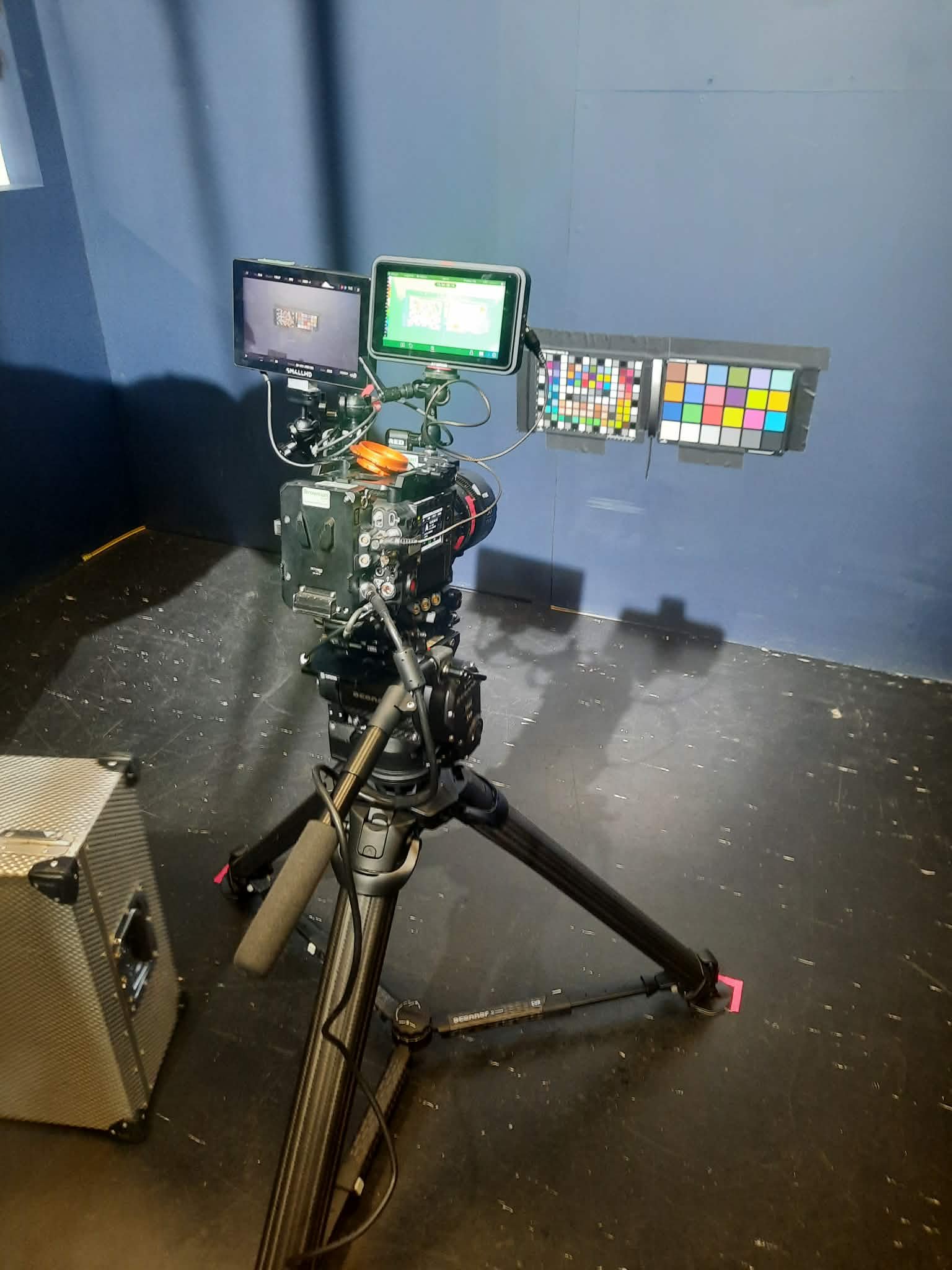
Spectra360 starts by building a large set of reference material for each stock, including controlled chart shots and real scenes. The goal is to cover the range of exposures and colors that show up in actual work—not just a single “perfect” setup.Measure thousands of points
From that dataset, Spectra360 extracts a high volume of samples (patch values and color regions) so the match isn’t based on a few hand-picked frames. More points means the transform is constrained by the overall behavior of the stock, not by a narrow example.Separate “camera behavior” from “film behavior”
Digital cameras have their own biases and quirks. Spectra360 isolates and accounts for that first, so the final result isn’t just compensating for the camera, it’s actually reproducing the film response as intended.Keeping only Data in the Matching Process
By staying faithful to the gathered data and working within tight constraints of what was produced by the negative and scans, we emulate based on the gathered data points only and that’s it.We use customs built tools in order to develop the matching process and further develop the process to get better and better results.